|
|
|
|
|
|
|
|
|
|
|
|
|
|
| |
|
|
| |
|
|
|
| |
|
|
|
| |
|
|
|
|
|
|
|
|
|
|
| |
|
|
 |
 |
|
Replay Basketball is easy to play!
We’ve designed Replay Basketball to be easy to play, whether you’re a
hard-core hoops fan or not! Pre-game setup is simple, and using our
specially-designed score sheets you can easily keep track of all stats
during the game. You can start off with the Basic Game and move on to more
details and options of the Advanced Game at your own pace.
Replay Basketball plays with three six-sided dice (red, white and blue) and
our unique deck of two-sided Play Cards, which serve as the game clock as
well as to trigger ball possessions and spell out rebound battles. And like
our baseball game, the game includes a
sturdy, attractive
Play Board, along with a comprehensive and fun Rare Play Booklet.
Let's get into a little more detail below... |
|
|
|
|
|
|
|
|
|
|
|
| |
 |
 |
Players rated in all areas of the game...
As in our baseball game, we rate players in many
different facets, offensively and defensively:
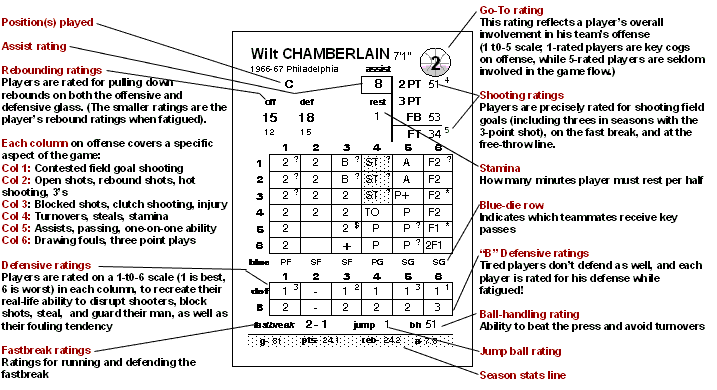
In addition...
●Each team is rated for its ability to win at home and on the road (Home
Court Advantage),
and for its ability to run and defend the fast break.
●Each player is rated for durability, as well as tendency to commit
technical fouls and even flagrant fouls.
Several strategic options are
available in Replay Basketball’s advanced mode. You can fastbreak at every
opportunity,
call for the full-court press, or slow things down with stall
tactics to burn extra ticks off the clock. There are options for rebounding
strategies designed to make the best use of your personnel and offset your
opponents’ strengths. All of these options allow you to make your Replay hoops
experience as simple or as detailed as you like.
|
|
|
|
|
|
|
|
|
|
|
| |
 |
 |
|
A look inside
Replay Basketball...
The Play Card Deck
Much of the action in Replay Basketball is triggered by the deck of two-sided
Play Cards. This deck is used for most possessions and rebounds, and it also
serves as the game clock (when the last card of the deck has been used, the
period ends). Here’s a quick look at how the two-sided Play Card deck
works:
|
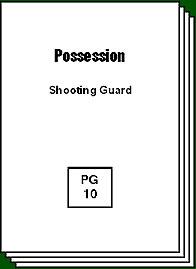
1. Start of Game
After the deck has been shuffled
to start the game, it should look like this (with the Possession side up). |
|
|
 |
|
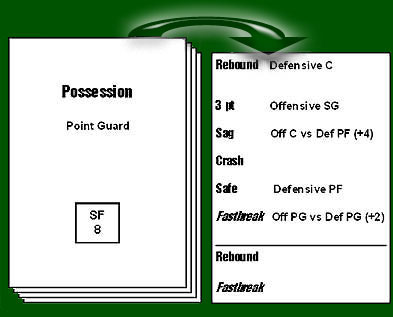
2. First
Possession
Once one team gains control of the ball
from the opening tip-off, flip the top card over (ignoring the first
Possession reading) to reveal the first set of Possession and Rebound
results to be used. This is how the deck should look: |
| |
 |
3.
Next Possession
Here we see that the opposing team's
Shooting Guard has control of the ball after the defensive rebound, so all
three dice are rolled and the result is found on the Shooting Guard's
card. |
|
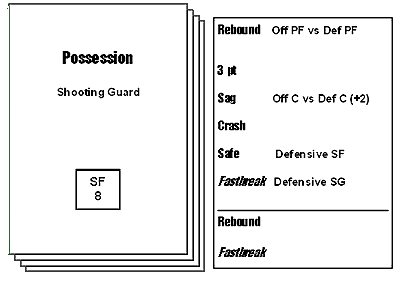 |
If he misses a shot, you would refer to the
top rebound result of the facing card, as in the previous example.
If he makes a basket,
you would flip the used top Play Card to reveal a new set of Possession
and Rebound results to begin the opposing team's next possession |
|
|
|
|
|
|
|
|
|
|
|
|
| |
 |
 |
|
Here's a sample of
game play... In our example, lets suppose
we've got the '69-'70 New York club against their rivals from Boston (circa
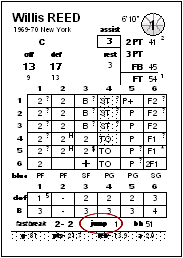
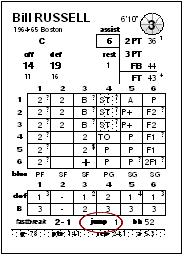
'64-'65), at Boston. Each game begins with a Jump Ball. We find the
two opposing centers' Jump ratings and go to the Jump Ball Chart.
 |
 |
Home
Player's
Jump
Rating |
Visiting Player's Jump
Rating |
|
|
1 |
2 |
3 |
4 |
5 |
|
1 |
43 |
45 |
53 |
56 |
63 |
|
2 |
34 |
43 |
45 |
53 |
56 |
|
3 |
26 |
34 |
43 |
45 |
53 |
|
4 |
23 |
26 |
34 |
43 |
45 |
|
5 |
14 |
23 |
26 |
34 |
43 |
|
(sample of Jump Ball Chart) |
|
|
Both players have Jump rating of 1, so we
find a "43" where they meet on the Jump Ball Chart. We roll two dice,
reading them Replay-style..
This is a "31" :

On the chart, the Home Team (Boston) wins the tap if the dice roll is less
than or equal to 43. Since 31 is within that range, Boston has
possession to start the game. |
|
|
|
 |
|
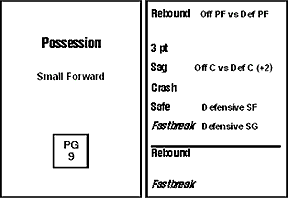
As we
have seen, possessions begin with a flip of the Play Card deck, to reveal a
new "Possession result. In this example, our first flipped play card's
Possession reading gives the ball to the Celts' Small Forward, who in this
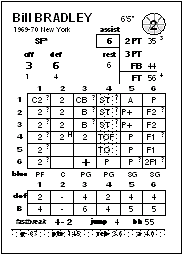
case is John Havlicek. "Hondo" is being guarded by the Knicks' Bill
Bradley. |
 |
 |
|
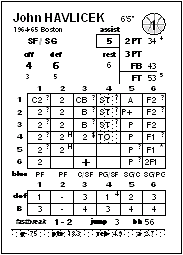
We roll
all three dice for Havlicek...

The red die tells us which column
to use on his card and his defender's card; the white die tells us
which row to use, and the blue die is used against the defender's
rating when needed. In this example, we find a result of
2
on Havlicek's card at square 2-2, which is an automatic basket (no need to
check the blue die against the defender here). Score two for Hondo!
Let's
try another dice roll...

This roll puts us at square 1-2 on Havlicek's card, where we find a
result of 2?. On any results with a ?, check the
blue die against the defender's rating in that column to resolve the play.
On a 2?, if the blue die is
higher than the defender's rating, the shot is no good. If
the blue die is not higher, the shot is
good. Bradley's column 1 defense rating is 2; since our
blue die reads 3, he forced a missed shot and the rebound battle
would be between the two teams' power forwards.
Let's
try one last roll...

This roll puts us at square 5-1 on Havlicek's card, where we find a
result of A. On this very valuable result, Havlicek has made a
pinpoint pass to a teammate for an easy bucket! On this play (and a
few others) the blue die is used on the passer's card in the "blue die" row,
to determine the player receiving the pass. On Havlicek's card, a blue
die roll of 1 gives the ball to Power Forward Tom "Satch" Sanders,
who nets the easy basket. Score an assist for Havlicek!
|
|
That's a
quick look at how the Play Cards, dice and player rating interact. To
keep play moving, most results are found on the Player Cards, and the
Play Board
explains the meaning of each of these results. (As you play you'll
quickly find these become committed to memory.) Occasionally a result
will be found on the Play Board or Fastbreak Chart. |
|
|
|
|
|
|
|
|
|
|
|
|
| |
|
|
|
|
|
|
|
|
|
| |
|
©2005 - 2015 Replay Publishing
All rights reserved. |
|
| |
|
|
|
|
|
|









